
PMF-PCF · Product portfolio rationalization, done as a diagnostic
Every product in your portfolio has a defender.
None of them has a verdict.
PMF-PCF is a structured diagnostic that scores every product on two axes — does the market want it, and can your company actually deliver and scale it? In four weeks you get a defensible invest / fix / divest / kill decision for each one, backed by data instead of the loudest voice in the room.
"30 minutes with me — bring your portfolio, I'll bring the questions." — Norbert · or write to me: contact@pmfpcf.com
Built on a benchmark of 81 C-level assessments30 years of product leadershipProducts generating >€1bn revenue per month
Sound familiar?
You don't have a product problem. You have a decision problem.
Your portfolio grew one reasonable decision at a time. Now every roadmap meeting is a negotiation, every product has a champion, and the honest question — should this product still exist? — never gets a straight answer. The symptoms are always the same:
Resources are spread like butter
Twenty products, three that matter, and nobody can say out loud which three.
The market says yes, the organization says later
Customers want the product — but support, processes, and engineering can't deliver it profitably at scale.
Decisions are made by anecdote
The last customer escalation, the founder's favorite, the sales rep who shouts loudest. No shared evidence, no shared verdict.
of products sit in the "Missing Link Zone" — decent market fit, decent organizational fit, excellent at neither. They don't fail. They just quietly consume the resources your winners need. And only 40.7% ever reach profitability. (Benchmark study, n = 81 senior executives, B2B & B2C)
The Framework
Two questions decide every product's future. Most companies only ask one.
Product-Market Fit (PMF) asks: does the market urgently want this?
Problem urgency, willingness to pay, differentiation, adoption readiness.
Product-Company Fit (PCF) asks the question that gets skipped: can
your company deliver, support, and scale this profitably? Strategic alignment,
leadership support, processes, resources, culture.
Frustrated Customers
The market wants it — your organization can't keep up.
Optimal Alignment
Invest and scale.
Deadweight
Nobody wants it, nobody can deliver it. Kill it.
Frustrated Organization
A well-oiled machine building the wrong thing.
The insight from 81 C-level assessments: the differentiator is almost never market demand — it's organizational readiness. Products in organizations that keep pace are profitable in 68% of cases; the rest stall at 50% or below. The problem is rarely the product. It's the company around it.
Fire Phone, Kinect, Google Glass — all built by companies that had achieved product-market fit many times before. PMF wasn't their problem. PCF was.
The Portfolio Lens
A strong product portfolio tells one story. Most tell twenty.
Scoring products one by one is only half of a portfolio review. The other half is what your portfolio says as a whole — because a portfolio is a strategy, whether you chose it or not.
The coherent portfolio
Products complement each other and build on each other. Every sale opens the next conversation, because the next product is the logical extension of the one your customer already trusts. Cross-selling stops being a sales initiative and becomes the architecture of the portfolio itself.
The grab-bag portfolio
Products that share a logo and little else. That's not automatically a problem — grown portfolios usually look like this. But it forces a question most leadership teams never answer explicitly: what is this supposed to become? Are you in fact serving two different customer types in two different markets? Then say so — and decide whether you're running one portfolio or two.
The diagnostic reads your portfolio at both levels: every product against market and company — and the portfolio against itself. Which products reinforce each other's story, which ones dilute it, and where a single kill decision buys more focus than a year of prioritization meetings.
How This Differs
Not another BCG matrix
The classic portfolio tools — BCG growth-share matrix, GE/McKinsey nine-box — compare your products against the market. Both axes look outward; they assume that if the market is attractive, your company can deliver. PMF-PCF pairs the market axis with the one they skip: whether your organization can deliver, support, and scale each product profitably.
How It Works
From gut feeling to verdict in four weeks
01
Structured assessment — week 1–2
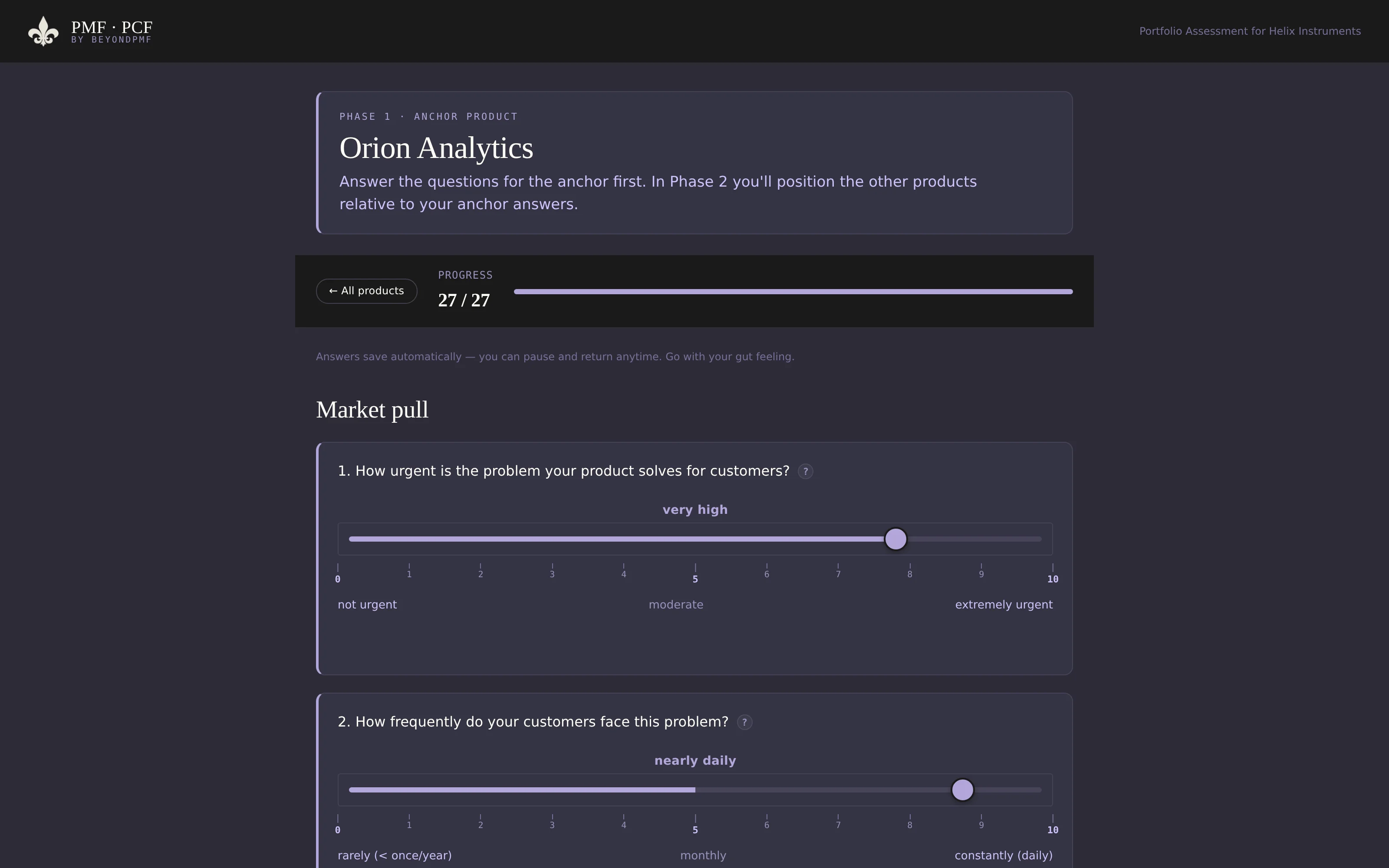
Your leadership team and key stakeholders score every product on 27 dimensions across PMF and PCF — independently, anonymously, on calibrated 0–10 scales. No workshops where the loudest voice wins. Optionally, external voices (customers, key opinion leaders, partners) are added on the market-facing dimensions.
02
Analysis & dissent mapping — week 2–3
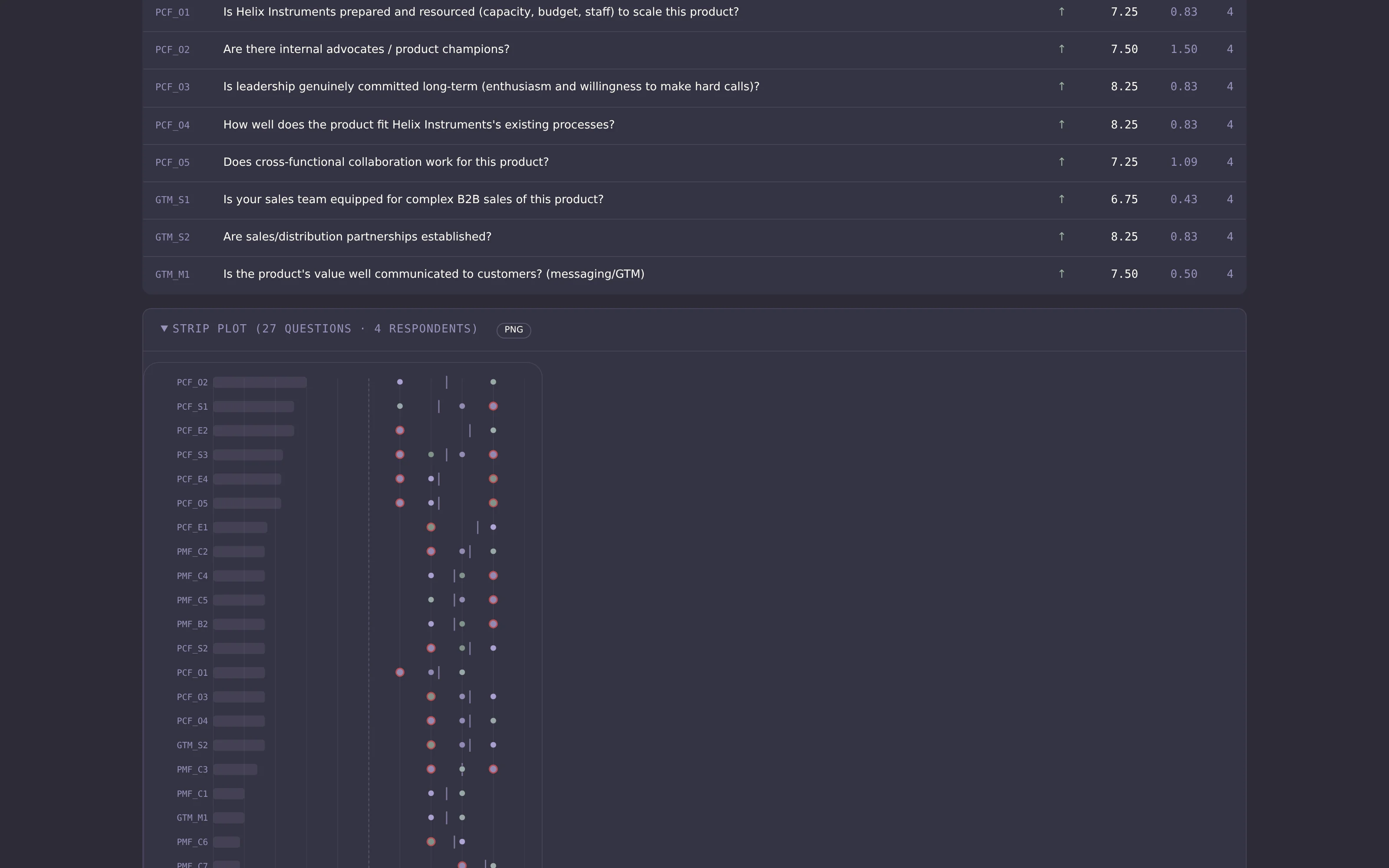
I don't just average the scores. The analysis shows where your team disagrees — where leadership is split, where the customer view contradicts the internal view, and where single outliers hide consensus. Disagreement is usually where the real conversation has been avoided.
03
Decision workshop — week 4
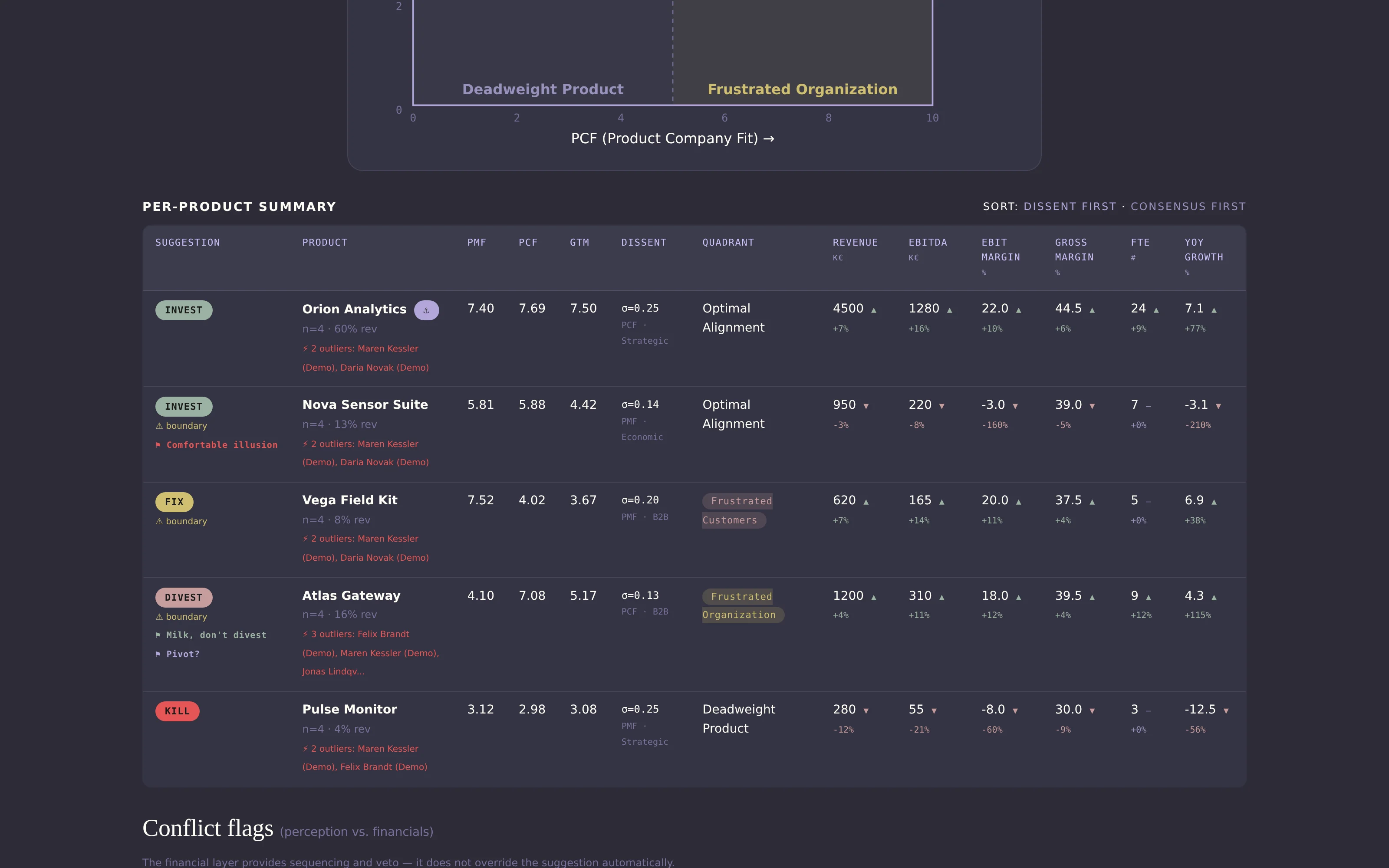
Every product positioned on the matrix with a data-backed suggestion: invest, fix, divest, or kill — including a ranking under resource scarcity. In a half-day workshop, you and I pressure-test the suggestions against your strategy and leave with decisions, not slides.
Inside the Tool
See the diagnostic at work
A focused interface for collecting perspectives and reading the verdict at a glance.
What You Get
Three things you'll have four weeks from now
A portfolio map
Every product on the PMF-PCF matrix, scored by the people who actually know, with dissent and outliers made visible instead of averaged away.
A verdict per product
Invest / fix / divest / kill, with the reasoning documented — so the decision survives the next leadership meeting and the next budget round.
A focus dividend
A ranked list of where freed-up resources go, so killing a product is the start of funding a winner, not just an ending.
Who's Behind This
Built by someone who has shipped, scaled — and killed — products for 30 years
The PMF-PCF method comes from me, Norbert Steinhauser: 110+ product launches, products generating more than €1bn in revenue per month, used in 70% of German households. Work with and for SAP, Siemens, Deutsche Telekom, 1&1, and others.
The framework is calibrated against a proprietary benchmark study of 81 C-level and senior executive assessments across B2B and B2C — so your scores aren't read in a vacuum, they're read against how other portfolios actually look.
Why not just ask your team, your consultants, or your NPS?
"We discuss the portfolio in leadership meetings."
Discussion without independent scoring measures persuasion, not fit. The structured assessment makes every voice equal — and makes disagreement visible instead of letting hierarchy resolve it.
"We could hire a strategy consultancy."
You'd get a bigger deck in more months at ten times the price — built from interviews with the same people the assessment scores directly. PMF-PCF gives you the decision layer without the army.
"Our NPS is fine."
NPS tells you whether customers like what you ship. It says nothing about whether your company can keep shipping it profitably. That's the half of the equation that kills products — and it's the half nobody measures.
Free Self-Check
Not ready to talk? Take the temperature first.
Get the PMF-PCF Self-Check — a one-page version of the diagnostic with the ten questions that predict most of the variance. Score one product in five minutes and see which quadrant it lands in.
Find your missing link
Every quarter without a verdict has a price
The cost of an undecided portfolio is invisible but compounding: your best engineers maintaining products nobody will defend in two years, your sales team selling things your organization can't profitably deliver. I run every diagnostic personally, end to end — which caps my capacity at a small number of engagements per quarter.
Let's look at your portfolio →One 30-minute call with me. You bring the portfolio, I'll tell you honestly whether the diagnostic fits your situation — and if it doesn't, I'll say so.
FAQ
Questions I hear before every diagnostic
What's the difference between PMF and PCF?
Product-Market Fit asks whether the market genuinely wants your product. Product-Company Fit asks whether your company is built to deliver and scale it — across strategy, capabilities, profitability, and culture. A product can have PMF and still stall because the company around it isn't aligned to scale it. That gap is the missing link.
How long does it take?
Four weeks from kickoff to decision workshop; your team invests roughly 45 minutes per person for the assessment.
How many products does it cover?
Designed for portfolios — from 5 to 25+ products or product lines. Single-product assessments are possible for major invest decisions.
Who needs to participate?
Leadership plus the people closest to product, sales, and delivery. Typically 5–15 raters. External raters (customers, partners) are optional.
How is our data handled?
Each engagement runs in a fully isolated environment with its own data store on EU infrastructure, keeping every organization's respondent data cleanly separated.
What if our scores are good?
Then you've bought certainty — and a documented baseline to re-measure against next year.
How is PMF-PCF different from the BCG matrix?
The BCG growth-share matrix scores products on market growth and relative market share — two external measures. It assumes that if the market is right, your company can deliver. PMF-PCF keeps the market axis (PMF) and adds the internal one the BCG matrix skips (PCF): whether your organization can deliver, support, and scale each product profitably. It's also measured differently — through structured, anonymous assessments by your leadership and the people closest to the products, not market statistics — and it ends in an explicit invest / fix / divest / kill verdict per product.
What makes a good product portfolio?
A good portfolio tells one coherent story: products complement and build on each other, so every sale makes the next one easier because it's a logical extension of the first. A portfolio of unrelated products isn't automatically bad — but it raises a question leadership has to answer deliberately: what should it become, and are you in fact serving two different customer types in two different markets? The diagnostic makes that portfolio-level picture explicit alongside the per-product verdicts.